

If you’ve ever stood in the fastener aisle staring at a wall of blind rivets wondering why some cost triple the price of others, you’re not alone. They look basically identical from the outside. The difference is what’s happening on the inside — and it changes how these things behave completely.
Let’s break it down.
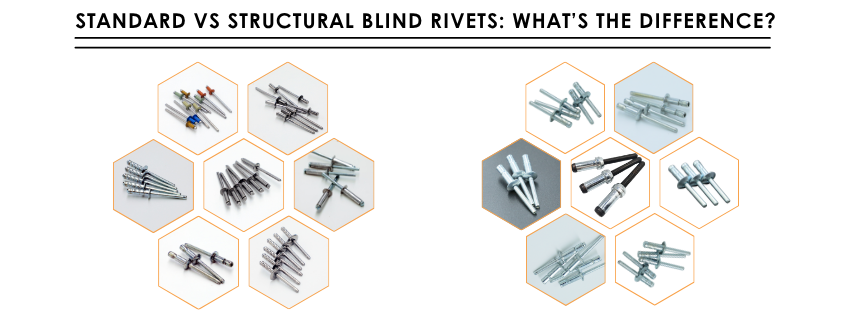
Quick Recap: What’s a Blind Rivet Anyway?
A blind rivet is a fastener you can install from just one side of a panel. No access to the backside needed, no bolts to hold in place while you tighten a nut. You drill a hole, pop the rivet in, squeeze the tool, and it flares out on the far side to clamp everything together. “Blind” because you never actually see that back side forming.
Two parts make this happen: the outer body (the part that stays in the hole) and the inner mandrel (the pin that gets yanked through and snaps off once the job’s done).
That mandrel is where the two types really part ways.
Standard Blind Rivets: What’s Going On Inside
This is your bread-and-butter rivet. Cheap, fast, everywhere.
When you set a standard rivet, the mandrel snaps off and either falls out or just kind of sits there loosely inside the now-hollow body. That hollow center is the giveaway — nothing’s really holding that middle section together besides the rivet body itself.
What that means in practice:
- Lower shear and tensile strength, since the body is doing all the work alone
- More prone to loosening or losing grip under vibration
- Sealing is hit or miss — that open channel through the middle doesn’t stop air or water reliably
- Lower cost, and installs with basic tools
Common types you’ll run into: aluminum, steel, stainless, and copper open-end rivets.
Structural Blind Rivets: What’s Going On Inside
Structural blind rivets solve the “hollow middle” problem by trapping the mandrel inside the rivet body instead of letting it fall out.
Depending on the design, the mandrel either locks itself into place mechanically or breaks off deep inside the sleeve, packing the center almost solid. The result is a rivet that behaves a lot more like a solid pin than a hollow tube.
What that means in practice:
- Roughly 2-3x the shear and tensile strength of a standard rivet the same size
- Much better resistance to vibration and repeated stress, since the mandrel can’t work its way loose
- Generally seals tighter, since there’s no open channel running through the middle
- Higher cost, and needs a rivet tool with more pull force to set properly
Common types: self-plugging and through-set/multi-grip structural rivets.
Side-by-Side
| Standard | Structural | |
|---|---|---|
| Mandrel after install | Falls out / sits loose | Locked in place inside body |
| Shear strength | Lower | Significantly higher |
| Tensile strength | Lower | Significantly higher |
| Vibration resistance | Moderate | High |
| Sealing | Inconsistent | Generally better |
| Cost per unit | Lower | Higher |
| Installation force needed | Lower | Higher |
The Core Difference, in One Line
A standard blind rivet is a hollow sleeve with a mandrel that leaves once its job is done. A structural rivet keeps that mandrel captured inside, turning what would be a hollow tube into something much closer to a solid pin — and that one design choice is responsible for basically every performance difference between the two.